A Practitioner's Blueprint
What does the book ENTAIL?
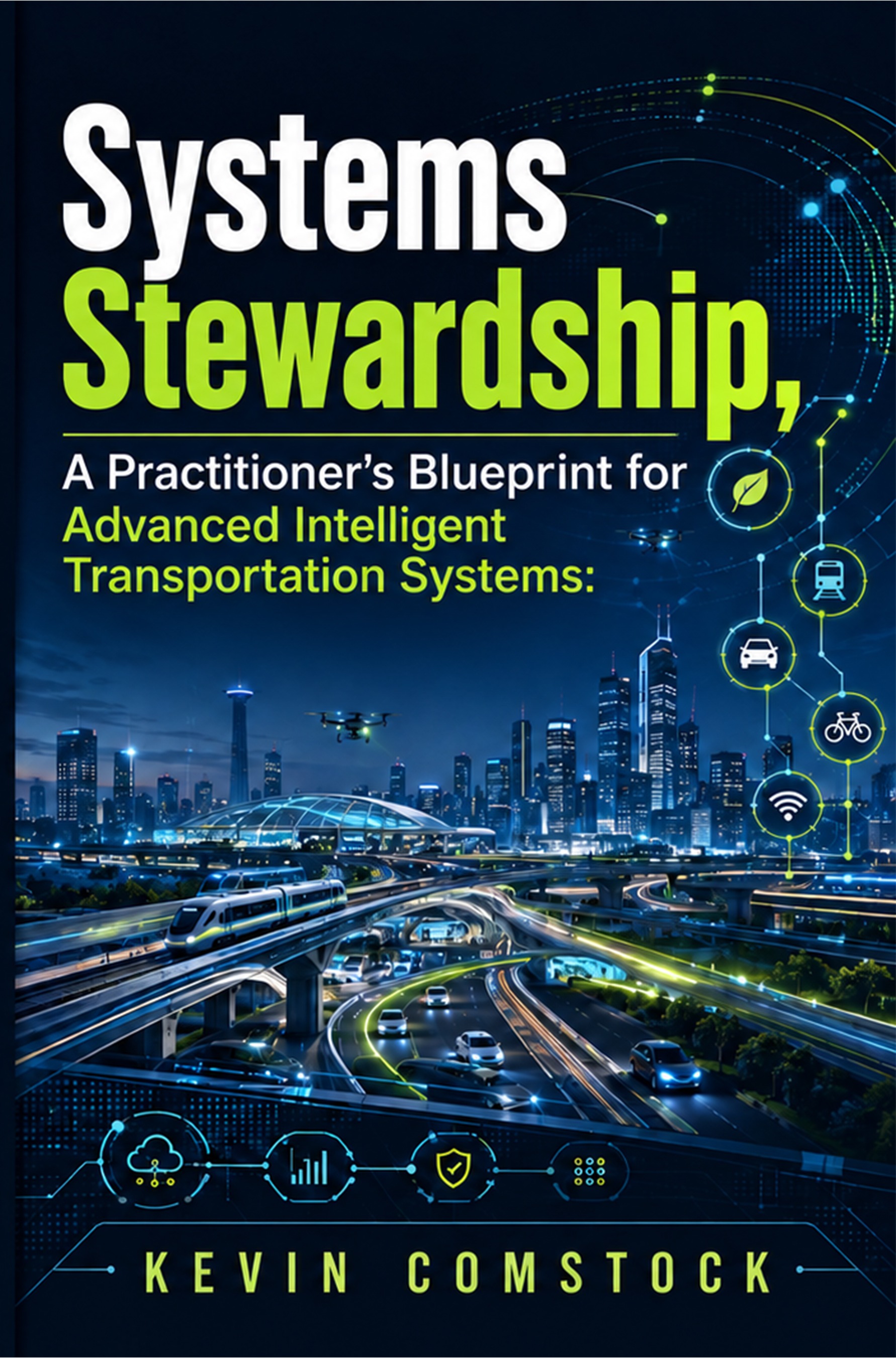
Systems Stewvardship is a practical guide to governing, operating, and sustaining intelligent transportation systems across their full lifecycle.
Most transportation systems are designed as projects. They have to be managed as systems.
A transportation system can look complete when it is deployed. The project may be closed,but the responsibility does not end there.
You'll witness:
- ● Technology changes
- ● Requirements change
- ● People change roles
Systems have to be modified, integrated with newer platforms, maintained, secured, and operated under conditions that were difficult to predict at the beginning.
That long period of operation is where stewardship matters most.
In Systems Stewardship, Kevin Comstock draws on more than 40 years of experience in ITS, TSMO, traffic signal systems, telecommunications, systems engineering, and public-sector technology leadership. The book brings those experiences together into a practical framework for thinking about transportation systems beyond individual projects and technology deployments.
The book introduces the Hybrid ""V",a lifecycle framework that connects civic need,systems understanding, operational design, testing, change governance, performance measurement, and sustained capability. The objective is to help practitioners build transportation systems that can continue to serve their communities as technology,requirements, and operating conditions change.
Core Themes & Principles
Key Highlights
Six areas form the foundation of the systems stewardship approach presented throughout the book.
Lifecycle Governance
Transportation technology needs governance throughout its lifecycle. Planning and procurement are important, but so are configuration, operations, upgrades, renewal, and eventual retirement.
TSMO
Transportation Systems Management and Operations provides the operational perspective needed to keep transportation systems performing after deployment. It connects technology decisions with network conditions, incident response, performance, and day-to-day operations.
Smart Infrastructure
Transportation infrastructure increasingly includes sensors, communications, connected devices, software, and data alongside traditional physical infrastructure. These elements have to work together if agencies are going to realize their intended value.
Systems Engineering
Systems engineering provides the discipline for understanding needs, defining requirements,developing architectures, managing interfaces, validating performance, and controlling changes as a system evolves.
Asset Management
Transportation technology is an asset with a lifecycle, dependencies, maintenance requirements, and replacement decisions. Effective asset management gives agencies a clearer view of what they operate and what is required to sustain it.
Public-Sector Leadership
Technology programs depend on more than technical decisions. Public-sector leaders have to connect technology with public needs, organizational capability, policy, funding,operations, and long-term accountability.
Structural Roadmap
What the Book Covers
The book is organized into four parts. Each part addresses a different aspect of systems stewardship, moving from the reasons a new approach is needed to the practices and capabilities required to sustain it.
The Case for Change
Transportation technology has developed rapidly, while many of the structures used to manage it remain organized around individual projects and disciplines.
This section examines six divides that create problems for transportation practitioners: education and field reality, analysis and consequence, plan sheet and street, assets and operations, civil and digital infrastructure, and technical competence and institutional capability.
How the Practitioner Portrays It
Recognize where these divides affect transportation programs and understand why lifecycle stewardship needs to be considered before deployment.
The Discipline
Stewardship requires a technical foundation.
This section examines systems engineering, architecture and interoperability, cybersecurity, validation, lifecycle stewardship, and configuration management. The emphasis is on the practices that allow complex systems to be understood, integrated, tested, operated, and changed.
How the Practitioner Portrays It
Apply systems engineering principles to the decisions that shape system performance throughout its lifecycle.
Evidence and Institutions
Transportation systems operate within institutions, and institutions shape how technology is selected, deployed, operated, and sustained.
Eight case studies provide practical evidence, including work involving the East M.L. King Boulevard Smart Corridor, pedestrian sensing, proactive safety analytics, CTwin, governance and policy alignment, statewide traffic incident management, and the development of a stewardship operating system.
How the Practitioner Portrays It
Examine what happens when technology, operations, institutions, policy, and public objectives have to work together.
The Road Ahead
Transportation technology will continue to change. Connected and automated vehicles, C-V2X, artificial intelligence, LiDAR, digital twins, and other emerging capabilities are already influencing how agencies think about future systems.
The challenge is deciding how to introduce these technologies while maintaining the systems already in service. What should be adopted? What needs more validation? How will it integrate with existing infrastructure? What skills and organizational capabilities will be required to operate it?
How the Practitioner Portrays It
Approach emerging technology with a lifecycle perspective and consider the operational and institutional capability required to sustain it.
The Book's Readers
Who This Book Is For
This book is written for people responsible for transportation systems at different points in their lifecycle, from planning and engineering through operations, management, and long-term stewardship.
State DOT & Agency Leaders
Leaders responsible for transportation technology programs, investment decisions, performance, operations, and long-term system capability.
Smart City & Municipal Directors
Public-sector leaders working across infrastructure, technology, data, mobility, and community priorities.
TSMO & Traffic Operations Engineers
Practitioners responsible for transportation operations, system performance, incident response, technology integration, and continuous improvement.
ITS Consultants & Systems Engineers
Professionals involved in requirements, architecture, systems integration, testing, deployment, cybersecurity, and lifecycle support.
Transit & Toll Authority Executives
Leaders responsible for technology assets, operations, system performance, and the services that transportation users depend on.
Emerging Practitioners
Engineers, planners, technicians, students, educators, and early-career professionals developing the technical perspective and institutional understanding needed to work with increasingly complex transportation systems.
Ready to build systems that last?
Get Your Copy of Systems Stewardship
Transportation systems have long lifecycles. Decisions made during planning and deployment can influence operations, maintenance, security, cost, and performance for years. Systems stewardship provides a way to think about those decisions as part of one continuous responsibility.